



The Church
Built near the mouth of the Petit-Rhône, the Church of Saintes Maries de la Mer had an important strategic position. Because at the time of its construction, in the 9th and 12th centuries, pirates were rampant on the coast and it was necessary to defend against invasions.
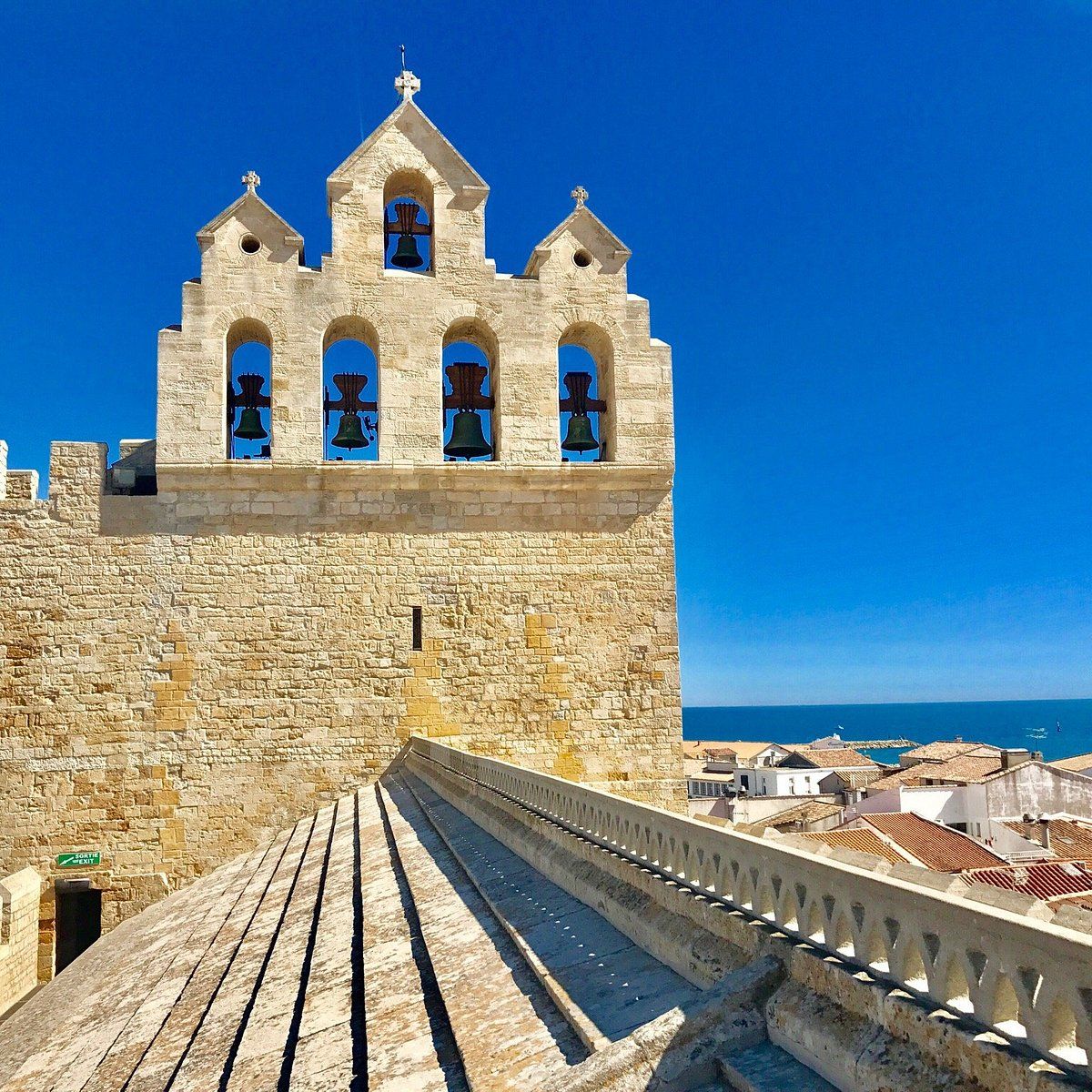
The church dominates the village and is visible from 10 km inland. It is a real fortress, formed by a single, straight nave, without ornament and 15 meters high. The roof is surrounded by a patrol path, with battlements and machicolations and served as a watchtower.
The choir and the apse are surmounted by a semicircular keep which contains the old guardroom called the "upper chapel". The walls of the church are pierced with arrow slits. It served as a refuge for the population and there is even a fresh water well there. Today, the statue of Sara, an essential element of the gypsy heritage, is placed in the crypt, to the right of the altar. Also noteworthy in the church is a pagan altar from the 4th century BC.
The massive stone vessel stands out against the expanses of flat land in the Camargue...
Lighthouse, sign of Faith, place of life of the Saints, setting of their Relics, call to the pilgrim...
The sanctuary, dedicated to the Virgin Mary invoked here under the name of Our Lady of the Sea, was built around a primitive church whose management Saint Caesarius of Arles, in his will of 543, entrusted to the monastery he founded in Arles with his sister Caesaria. This small church was itself built around a fresh water well still visible in the sanctuary and near which, it was thought, the Saints were buried.
The most contemporary historians place the construction of the fortified church during the second half of the 12th century while others date the nave from the 11th century and the part corresponding to the choir from the 9th century. Due to the repeated incursions of looters coming from the sea, it was necessary to offer a refuge to the inhabitants and protect the place where the Saints rested. In the 14th century, the fortifications of the upper part were raised, providing the building with the means of defense of a fortified castle: patrol path, machicolations, keep in the heart of which a room was fitted out. This room was perhaps a guard room. It became an upper chapel dedicated to Saint Michael. Everything was done to resist the attackers: the roof is covered with stone slabs, the openings are rare and small.
In August 1448, after the discovery of the bodies of the Saints, King René of Anjou had the current crypt built, the primitive church that had been preserved was destroyed, the shrine containing the relics was raised to the upper chapel. It is accessed via the roof terrace by taking spiral staircases built into the thickness of the walls.
The sanctuary of Our Lady of the Sea is the place of the great pilgrimages of May, October and December, but not only. Pilgrims are also present daily, in groups, with their families, alone, who have come to confide their joys and sorrows... The person who enters the sanctuary is welcomed. Welcomed by the thickness of two thousand years of prayer, welcomed by Our Lady of the Sea, welcomed by the Saints... Let us raise our eyes! Up there, in the setting of a large window, the Shrines that guard the precious Relics... Other stairs descend under the choir, into the crypt where Saint Sara is venerated.
Pilgrim... Visitor... Visitor turned pilgrim... Whoever enters the sanctuary experiences an intimate encounter...