


The Gardian Huts
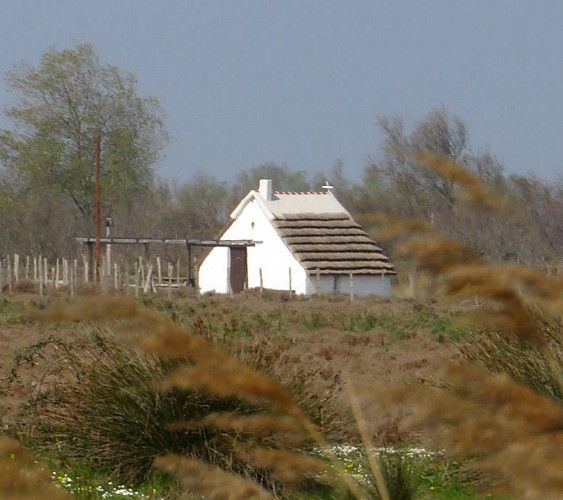
Home to guardians, fishermen and shepherds, the hut is recognizable by its geometric volume, a juxtaposition of a parallelepiped, a cylinder, a cone and a prism.
The traditional architecture of this hut is the result of simplicity and ingenuity. Its apse turns its back on the mistral.
This dwelling with low whitewashed walls has a large roof crossed by a rafter, the end of which is sometimes topped with a bull's horn or a transverse piece of wood to form a cross. This rafter, placed opposite the apse of the cabin, keeps lightning away and is used to tie the rope that anchors it to the ground on windy days.
In the past, the walls of the huts were built with materials from the marshes: clay and reeds. Today, other materials are used… but its architecture is still appreciated for the pleasure of keeping tradition alive or simply for its adaptation to climatic conditions.