

Breeding
The Camargue Horse
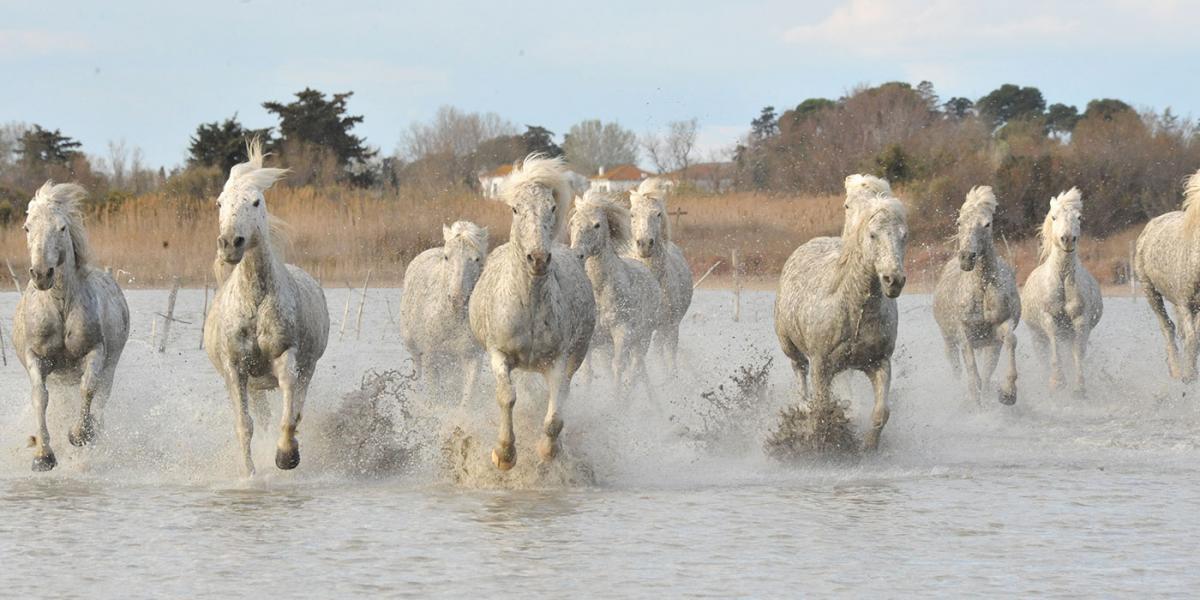
Characterized by its small size, its coarse skeleton and limbs, its heavy head, the Camargue horse is recognized in adulthood by its light gray coat. However, the foal is born dark bay, and it is only around 4-5 years old that its coat becomes lighter.
With unequaled hardiness, the Camargue horse lives in semi-freedom in the marshes and enganes in summer and winter alike. Herds consist of a number of broodmares and a stallion; the births take place from April to July in full freedom. At the age of one year, the foal is branded with a hot iron by its owner and separated from its mother.
When he was three years old, he was caught to be trained, a delicate operation which required a great deal of patience from the herdsman who, day after day, had to put the animal in confidence. It is led in a hand rein, thus freeing the rider's right hand. In most herds, only males are trained, mares being bred for breeding.
Its use is now broadening to multiple disciplines of leisure, sports and hiking.
The Camargue Horse Breed has been officially recognized by the National Stud Farms since March 17, 1978. It has its Stud-Book and its breeders are grouped into an Association, the AECRC (Association of Breeders of Race Camargue Horses)
To date, 246 breeders are listed, including 156 in the cradle of the breed which extends from Montpellier to Fos sur Mer via Lunel, Tarascon and Salon de Provence.
The Camargue Bull
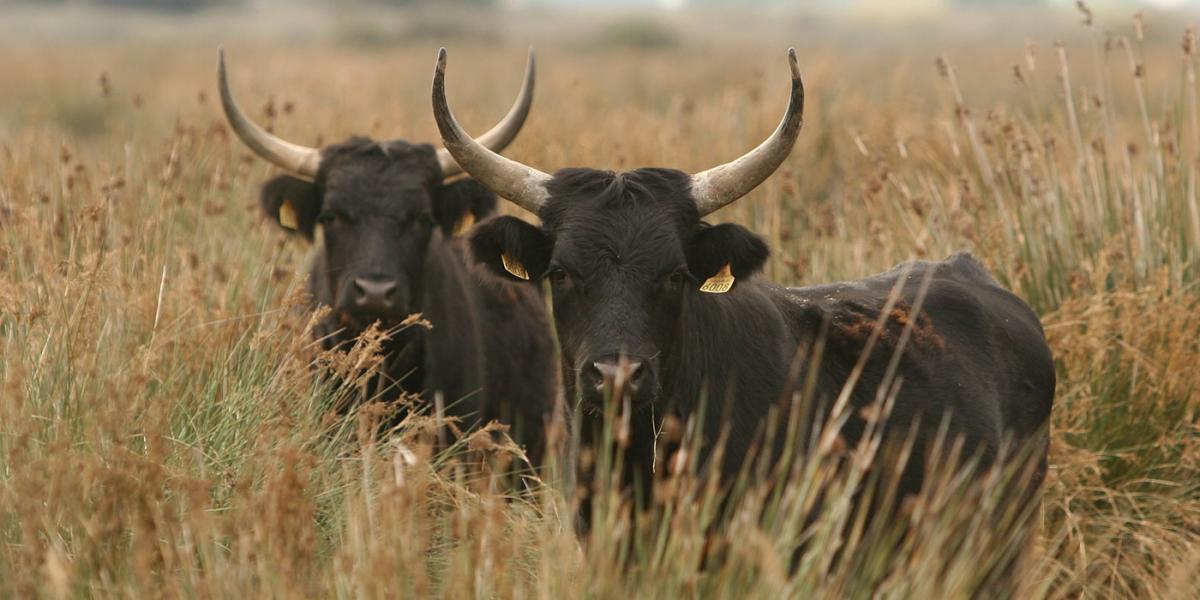
Shaped by the environment in which it lives, the Camargue bull is a hardy pedigree animal. Camargue cattle live in herds called "manade" and their breeding and rangeland is made up of expanses of marshes and territories of natural spaces. It is slender in size, not exceeding 1m30, with a thin head. Her dress is always very dark. The horns are the most typical characteristic of the breed, they point vertically towards the sky forming mainly in females a perfect lyre.
The Camargue bull could never be domesticated, and the conservation of the breed is only due to its playing and racing skills. Rustic and resistant, its breeding is practiced today by 120 herdsmen bringing together around 15,000 heads.
The breeding of the bull, like that of the Camargue horse, is an extensive breeding.
It was only at the end of the 1990s that bull meat became one of the rare beef products to benefit from the Appellation d'Origine Contrôlée.
It lives in herds (herds), in semi-freedom on land unsuitable for cultivation on which only reeds, salicornia grow, which constitute its only food.
Like the foal, the calf will be branded at 1 year old with a hot iron (ferrade).