


The Pilgrimage
The Pilgrimage of the Gypsies
Roma, Manouches, Gypsies and Gypsies arrive from all over Europe and even from other continents to venerate their Saint, Sara the Black. They settle in the streets, in the squares, by the sea. For eight to ten days, they are at home here. The pilgrimage is also an opportunity for reunions and most of the children are baptized in the Church of the Saints.
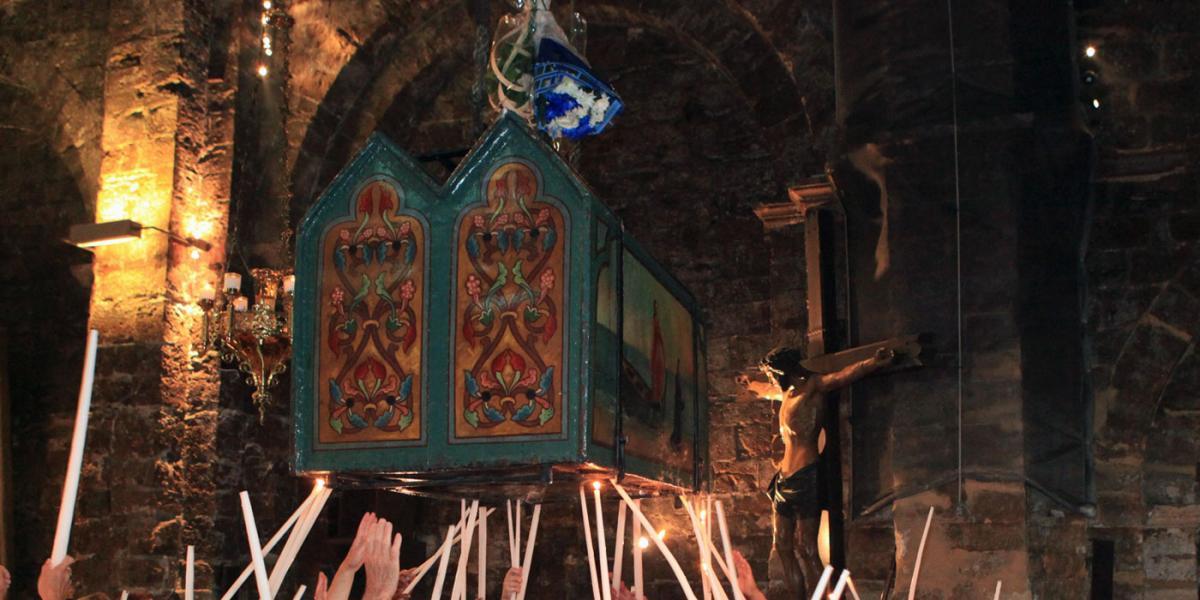
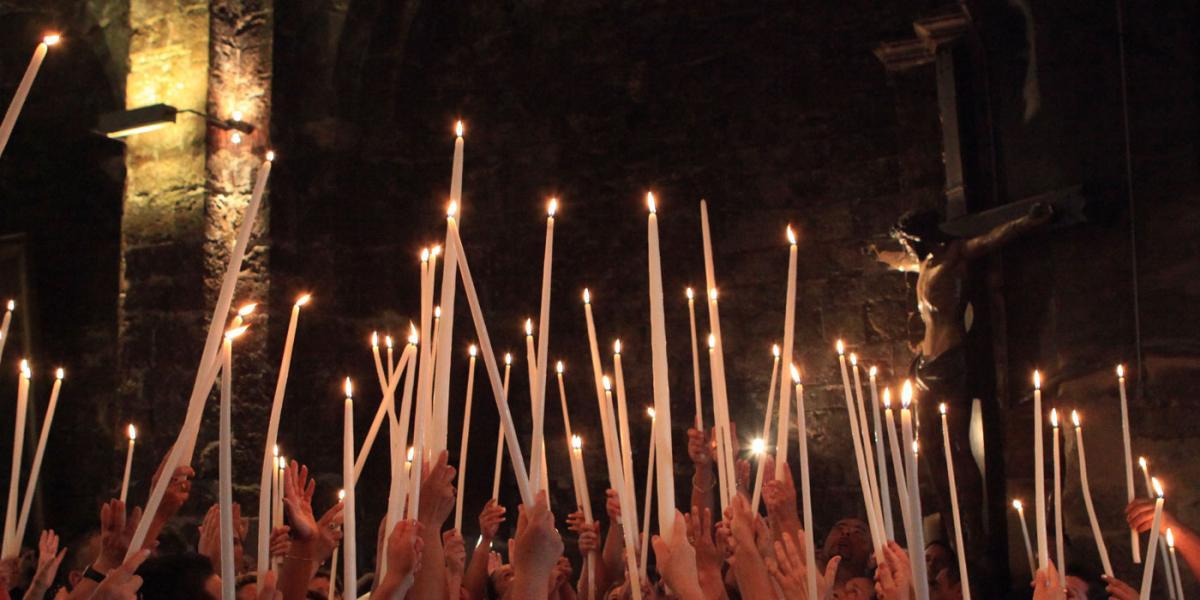
Following the descent of the shrines on May 24, the statue of Sara is carried by the gypsies to the sea to symbolize the expectation and welcome of the Saintes Maries by Sara, patroness of the gypsies. The procession then returns to the church in the joy of cheers, musical instruments and the chime of the church bells.
The statue of Sara is in the crypt of the church, to the right of the altar, dressed in multicolored dresses and jewels.
Legends and Beliefs
HOLY WOMEN AND THEIR MESSAGE
Our Saints, Marie-Salomé and Marie-Jacobé, are known to us through the Gospel (Mt 27,55-56; Jn 19,25; Mk 15,40-41; 16,1-7, ...). They are not a “legend”!
Marie-Salomé, named Salomé or Mother of the sons of Zebedee in the Gospel, had two sons: Jacques le Majeur, first bishop of Jerusalem and venerated in Compostela, and Jean the Evangelist.
Marie-Jacobé, called in the Gospel Marie de Cléophas, Marie mother of Jacques and Joseph or Marie de Jacques, hence her name Marie-Jacobé, had four boys, including the apostles Jacques le Mineur and José.
In the tradition of the cult of the Three Marys and the Holy Kinship, of which a very beautiful one was painted in the 16th century on the "surciel" of the upper chapel, Salomé and Jacobé, daughters of Saint Anne, are half-sisters of the Virgin. Married. They are among those who “had followed Jesus from Galilee to serve him” Mt.27,55. They followed him to the foot of the Cross with his Mother, Saint John and Mary Magdalene. On Easter Sunday, the three “bought perfume to go and embalm the body of Jesus” Mk.16,1 and went to the tomb. They are the first witnesses of the Resurrection: “Are you looking for Jesus of Nazareth, the Crucified? He is risen. »Mc.16.6
During the persecution of Christians in the 1945s, they were driven out of Palestine and landed here, on the Camargue shore, in the company of Marie-Madeleine, Marthe, Lazare, Maximin and other disciples. This is where they ended their lives.
The Holy Women are the first messengers of the Good News of the Resurrection. They bear witness to the Easter event that they experienced and recount the Word of Christ that they received from his mouth and meditated on for a long time. It is here, in the Camargue, that they ignite the fire of the Christian Faith which will then spread throughout Gaul and far beyond.
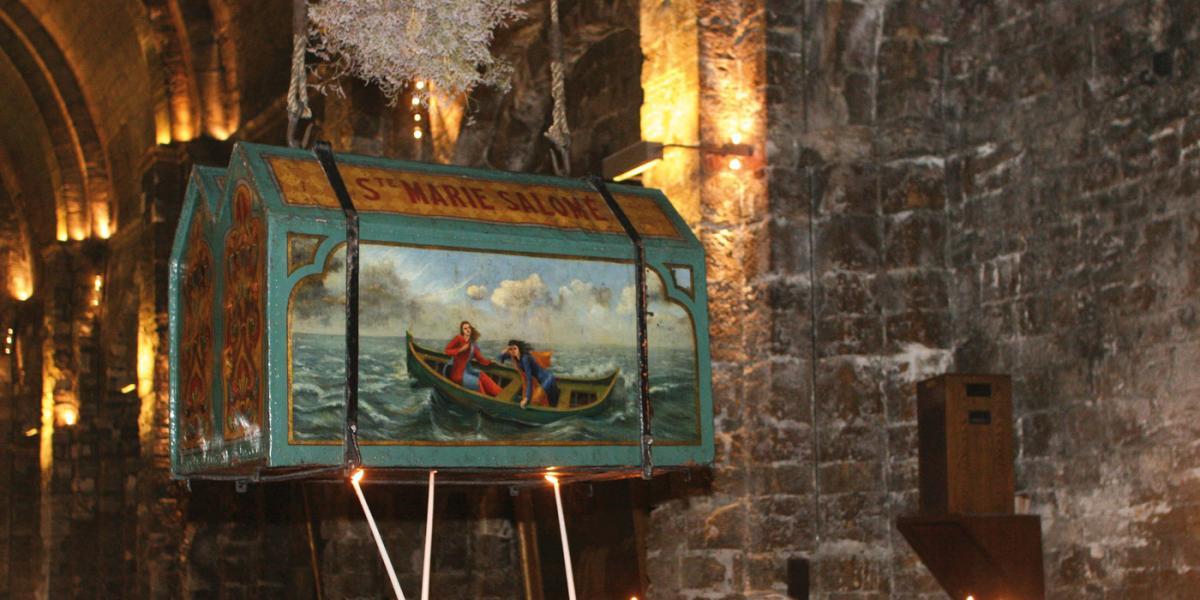
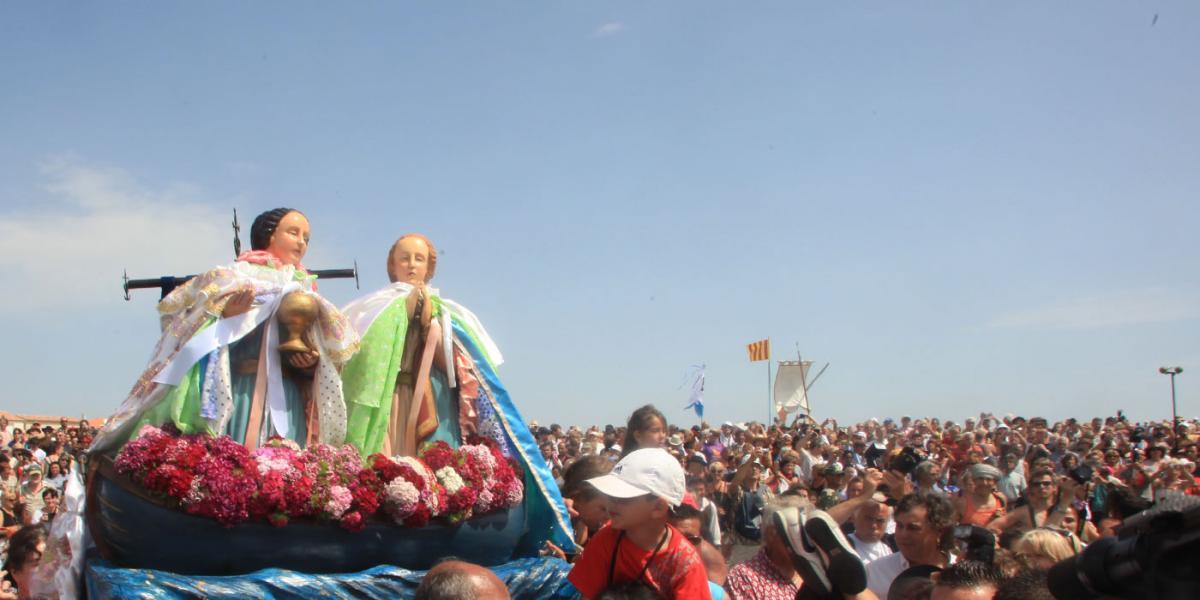
In the sanctuary, one can see the "Barque of the Saints" which is carried in procession to the sea during the pilgrimages of May and October. This representation is highly symbolic. Tradition says that, driven out of Palestine, they are pushed into the sea on a boat without sail or oar, promised to certain death. What is left to them except Faith, except Hope? In this boat, the Saints are represented with the vases of perfume that they bought to embalm the body of Christ. You have to imagine them hurrying towards the tomb of Jesus, which they know has been closed by a huge stone. Three women! To move the stone?! Madness? Yes, madness of Love... Hope against any strictly rational analysis of the situation... There it is, the message of the Holy Marys: “Christ is risen! Love is victorious and takes us into Hope! »
It becomes clear why in 2013, year of Faith, the Archbishop of Aix and Arles Mgr Dufour proclaimed the sanctuary of Saintes-Maries-de-la-Mer “Gate of Faith”!
WHO IS SAINT SARA?
The cult of Saint Sara is very old and, at the same time, her identity remains an enigma. Bishop de Provenchères, in 1967, officially recognized Sara's seniority and the veneration of which she was the object: “The cult of Sara is an immemorial cult. That's why I keep it in its traditional form. ".
In 1357, Jean de Venette, a Parisian Carmelite, wrote a long poem on the history of the Holy Women and mentioned “Sarrette”, their “chambermaid”. Vincent Philippon writes, around 1521, a history of the Saints and shows Sara collecting from the inhabitants what to feed the small Christian community. Both show her associated with Marie Salomé and Marie Jacobé.
On an oil invoice from 1684, it is mentioned that part of the oil is intended for the lamps of the "chapel of Saint Sarre".
We rely on an apocryphal letter of James in the second century the tradition which "presents her to us as the humble servant, the familiar, weeping on the shore for the departure of her mistresses Jacobé and Salomé, whom the fury of the Jews threw with others in this boat without sail or oar. Revolted, Sara wants to share the fate of the condemned, whatever it may be. So, Salomé throws her coat on which she walks through the waves and comes to take her place next to her friends. (Article by Father Causse published in April 1999 in La Roulotte, journal of the chaplaincy of gypsies). Many paintings represent her in the boat with the Saints, who came with them from Palestine.
Saint Sara is not a black Virgin, namely Mary Mother of Jesus represented black as in Le Puy-en-Velay. She is the Patron Saint whom the gypsies have chosen and whom they celebrate with fervor during the pilgrimage of May 24 which is dedicated to her. Placed in the crypt, it is covered with prayer cloaks.
Sara, who believed in the Resurrection of Christ and who faithfully accompanied the Saints until their death, is a figure of faith and fidelity that everyone can imitate.
The Pilgrimage of Saints
Since the 12th century, the Saintes Maries have been a place of pilgrimage. The relics of the Saints discovered in 1448 during excavations ordered by King René are particularly venerated during two pilgrimages.
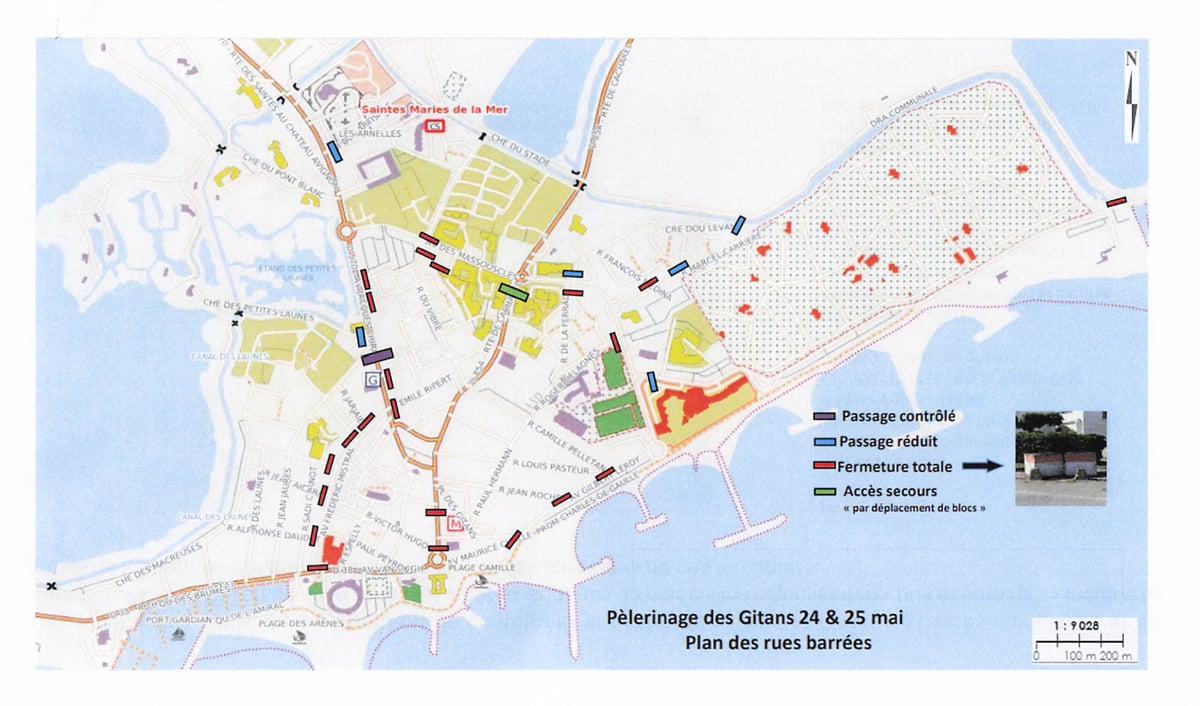
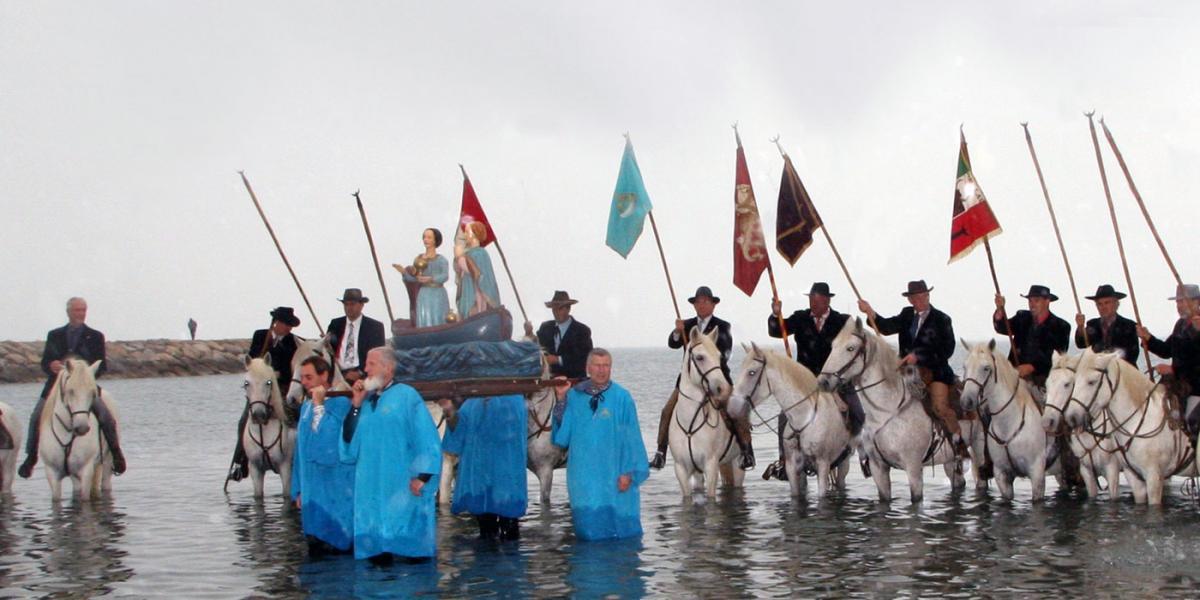
The best known takes place on May 24 and 25 each year with the participation of gypsies. The day of the 25th is devoted to the Saints of the village, Marie Jacobé and Marie Salomé, led in procession to the sea. Carried by the gypsies, surrounded by the crowd of faithful, Arles women and guardians in traditional costume and pilgrims from all over the world. , they are blessed by the Bishop. During these two days, offices and prayers follow one another in the church.
The second pilgrimage takes place on the Sunday closest to October 22. Pilgrimage of locals, it becomes more and more frequented. On Saturday evening, the Evocation of the Arrival of the Saints, a sound and light show on the beach, free, attracts the crowd of faithful and spectators from the region.
The Brotherhood of Saintes-Maries
The Confrérie des Saintes was born in 1315 with the approval of the Archbishop of Arles, Gaillard de Falguières and officially recognized on charter n°38 dated November 29, 1338 with the aim of honoring the Saintes Maries and under their protection.
The goals of the Brotherhood were specified by President Henri VICENTE before Mgr DUFOUR, Archbishop of Aix and Arles, during his pastoral visit in October 2011:
- Participate in the animation and work to promote the pilgrimages.
- Make this association known and stay in touch with the other Brotherhoods.
- Maintain the Upper Chapel, and provide for the necessary works and repairs.
- Develop a social function by providing help and comfort to people in difficulty.
- Develop relationships of respect and trust with the Traveler people.
The December Pilgrimage
Organized on the first weekend of December, this pilgrimage commemorates the Translation of the Relics.
Saturday : Descent of the Shrines Ceremony in the afternoon, followed at 9 p.m. by a torchlight procession; the Barque des Saintes is then carried in procession by the members of the Brotherhood followed by the faithful. The procession forms at the foot of the Cross of Jerusalem near the bullring and heads through the small streets of the village to the Church of Our Lady of the Sea.
Sunday : Solemn Mass followed, in the afternoon, by the ceremony of the Ascent of the Châsses.